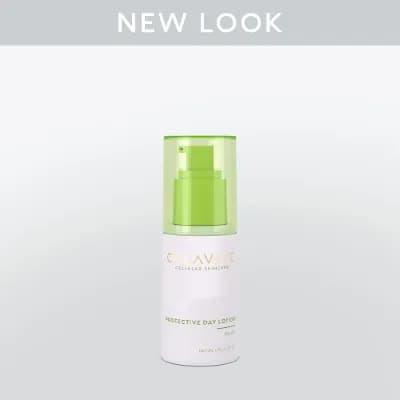
Protective Day Lotion
- Select the correct language/country and click OK, otherwise USANA cannot deliver your order.
- After entering the page, click the black banner at the top to register as a Preferred Customer and save 10%.
Member, auto order and retail prices for every product — on the page, plus the official PDF.
Protective Day Cream vs Day Lotion video overview
An English-language overview of the two Celavive day-protection products: how UVA and UVB differ, why four UV filters are used together, how to choose between the cream and the lotion by skin type, and how to apply and reapply them.
Open on YouTubeProtective Day Lotion
Cleanser, toner, serum — you do all of it before you leave the house. The step that gets skipped is the last one, and without it everything you did before it gets undone by the sun, a little at a time. Protective Day Lotion is the lightweight one: it moisturises just as well, without adding excess oil or grease, and is made for oily and combination skin. Sunscreen labelling differs by market; this page uses the Australia and New Zealand labelling: Broad Spectrum SPF 15.
How to Use
Shake the lotion first, then a pearl-sized amount on the face and neck; in order, your serum goes under your sunscreen. Three rules: apply generously and evenly 15 minutes before sun exposure; reapply at least every two hours; a higher SPF does not mean more time in the sun. Swimming or sweating, use a water-resistant sunscreen. For amount, frequency and cautions follow the current product label, and discontinue use if irritation occurs.
Explore this skincare category
Read the related skincare guide
PROTECTIVE DAY LOTION
The last step of your morning: hydration and broad-spectrum UVA/UVB protection in one. The lightweight one — it moisturises just as well, without adding excess oil or grease — made for oily and combination skin. Sunscreen labelling differs by market; this page uses the Australia and New Zealand labelling: Broad Spectrum SPF 15.
KEY BENEFITS
- Broad spectrum: UVA ages the skin, bringing wrinkles and dark spots; UVB burns it. SPF measures only burning, which is UVB — so the label also has to say broad spectrum.
- Four UV filters formulated together cover a broader spectrum of light and give more complete coverage on the skin.
- Hydration and day protection in a single step, absorbing quickly, so the morning routine stays short.
- A lightweight texture that does not add excess oil, made for oily and combination skin; dry and sensitive skin should choose Protective Day Cream.
KEY INGREDIENTS
- Four UV filters: avobenzone protects mainly against UVA; octocrylene absorbs UVB and stabilises avobenzone, which degrades in light over time; homosalate absorbs UVB; octinoxate is another UVB absorber.
- Olivol Botanical Blend (olive, watermelon rind, apple and lentil extracts): gives skin a full 24 hours of plumping hydration.
- Shea butter: long-chain fatty acids that absorb quickly and help restore moisture.
- Soybean extract: behaves like ceramide-3, a natural lipid in your skin's barrier. Ceramides make up as much as half the lipids in the outer layer.
- Three botanicals: a ginseng complex (Korean, American and Siberian ginseng) for antioxidant action and a firmer look; Eijitsu rose, which helps tighten and refines the appearance of pores; and sweet basil extract, an antioxidant that soothes skin after sun exposure.
FORMULA
The two day-protection products share the same SPF and most of the same ingredients; they differ in texture and in the skin they were made for. Dry skin lacks oil and tends to flake; dehydrated skin lacks water and feels tight. Oily skin can be dehydrated too, and dehydrated skin can produce more oil trying to correct itself — most skin needs more water, but not all skin needs more oil. This is the lightweight one, made for oily and combination skin.
HOW TO USE
- Use it as the last step of your morning routine: cleanse, tone, treat, protect.
- Shake first, then a pearl-sized amount on the face and neck; your serum goes under your sunscreen.
- Apply generously and evenly 15 minutes before sun exposure.
- Reapply at least every two hours; a higher SPF does not mean more time in the sun.
- Swimming or sweating, use a water-resistant sunscreen.
ABOUT THE LABELLING
Sunscreen labelling differs by market: this page uses the Australia/New Zealand Broad Spectrum SPF 15 labelling, and the same formula is labelled differently in some other markets. Always follow the pack you actually buy.
Formulas and details may change. Please refer to the official USANA website for the latest information. Statements are based on product label information. This content is for reference only and is not medical advice.
What It Targets
- Made for oily, combination skin. Dry and sensitive skin should look at Protective Day Cream — same SPF, most of the same ingredients, but they were not made for the same skin.
- There are two kinds of ultraviolet light: UVA ages the skin, bringing wrinkles and dark spots; UVB burns it. SPF measures only burning, which is UVB — it does not measure UVA. So the number on its own is not enough; the label also has to say broad spectrum.
- Four UV filters together: avobenzone protects mainly against UVA, octocrylene and homosalate absorb UVB, and octinoxate is another UVB absorber. Filters formulated together cover a broader spectrum and give more complete coverage; octocrylene does one more job — it stabilises avobenzone, which degrades in light over time.
- Lightweight texture: it moisturises just as well, without adding excess oil or grease.
- The shared moisture base: the Olivol Botanical Blend — olive, watermelon rind, apple and lentil — gives skin a full 24 hours of plumping hydration.
- Shea butter brings long-chain fatty acids that absorb quickly and help restore moisture; a soybean extract behaves like ceramide-3, a natural lipid in your skin's barrier — ceramides make up as much as half the lipids in the outer layer.
- Three botanicals finish the formula: a ginseng complex from Korean, American and Siberian ginseng for antioxidant action and a firmer look; Eijitsu rose, which helps tighten and refines the appearance of pores; and sweet basil extract, an antioxidant that soothes skin after sun exposure.